7 Seafood Mistakes That Ruin Dinner Before the Pan Gets Hot
Quick Answer: The most common seafood failures happen before cooking: buying fish that sat too long, storing it in the warmest part of the fridge, thawing it at room temperature, skipping the dry-off, salting at the wrong time, cutting fillets to uneven thickness, and starting from fridge-cold. Fix those seven and technique matters far less than you think.
You can have perfect pan control and still serve a mediocre piece of fish. The variables that decide texture and flavor are mostly settled before the burner goes on — and number four is the one experienced cooks still get wrong.

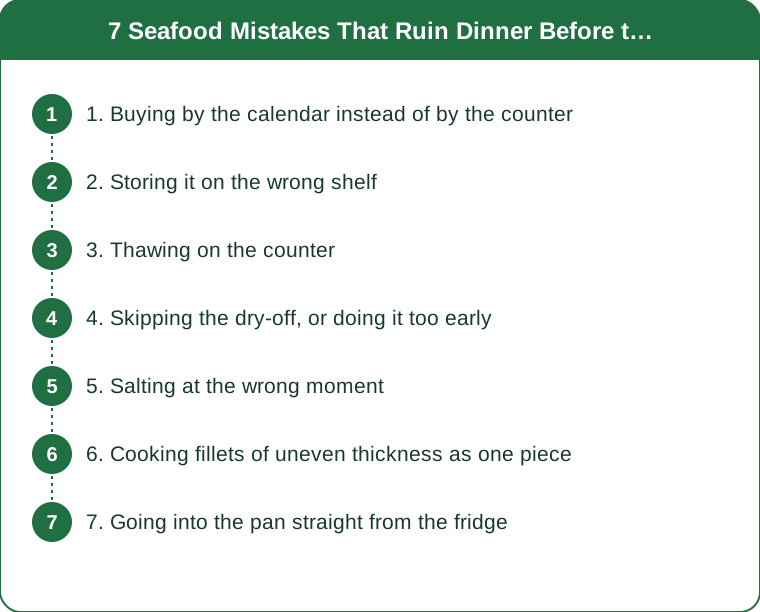
1. Buying by the calendar instead of by the counter
Fish doesn’t run on the same clock as the store’s ordering schedule. Ask one question at the counter: when did this come in?
A good fishmonger will tell you plainly, and the answer changes what you should buy. Fillets that arrived today are worth cooking tonight. Fillets on day three are worth a marinade, a stew, or a hard pass.
What to actually look at: flesh that springs back when pressed, no gapping between muscle flakes, and liquid in the tray that’s clear rather than milky. Milky liquid means protein breakdown is already underway.
And the tired advice about smell is half right — fresh fish smells like clean seawater or nothing at all. The moment you register anything ammonia-adjacent, it’s well past.
2. Storing it on the wrong shelf
Your refrigerator has a 7 to 10°F gradient from top shelf to bottom, and the door is warmer still. Fish stored on a middle shelf is sitting several degrees above where it should be.
Seafood wants 32 to 34°F — colder than almost anything else you own. The coldest zone is the back of the bottom shelf, above the crisper.
Better still: set the wrapped fillet in a shallow dish, lay a zip bag of ice on top, and put the dish on that bottom shelf. That’s a home version of the ice bed the counter uses, and it buys you roughly a day of quality.
What not to do is leave it in the plastic bag it came in, sitting in its own liquid. That’s a warm, wet environment for exactly the bacteria you’re racing.
3. Thawing on the counter
Frozen-at-sea fish is often better than counter fish, but only if you thaw it correctly.
Counter thawing puts the outer half-inch into the bacterial danger zone for an hour or more while the center is still solid. It also causes uneven moisture loss, which is why counter-thawed fish so often cooks up spongy on the outside and raw in the middle.
Overnight in the fridge is the gold standard. In a hurry, seal it and submerge in cold water for 20 to 30 minutes, changing the water once.
Never thaw in the vacuum pack it came in — the anaerobic environment is a genuine botulism concern with fish. Slit the bag first. This one is worth being fussy about.

4. Skipping the dry-off, or doing it too early
This is the one experienced cooks still get wrong, and it’s entirely about timing.
Surface moisture must evaporate before browning can start. A wet fillet steams itself, sticks, and never develops a crust. So everyone knows to pat it dry.
What’s less known: patting dry ten minutes before cooking isn’t enough, because salted or refrigerated fish keeps weeping. The technique that works is a dry-off, then 10 to 20 minutes uncovered on a rack in the fridge, then a second pat immediately before the pan.
That second pat is the whole trick. The first one removes packaging moisture; the second removes what came back.
5. Salting at the wrong moment
Salt pulls moisture out through osmosis, then — given enough time — the resulting brine gets reabsorbed and seasons the flesh throughout.
The trap is the middle window. Salt 5 minutes ahead and you’ve drawn moisture to the surface with no time for reabsorption, which is exactly the wet surface you just worked to eliminate.
Two workable options: salt immediately before it hits the pan, or salt 40 minutes ahead and let the cycle complete. For fillets under an inch, immediately-before is simpler and just as good.
Rough amount: about ¾ teaspoon of kosher salt per pound, and go lighter on anything you’ll finish with a salty sauce.
6. Cooking fillets of uneven thickness as one piece
A salmon fillet can easily run 1.5 inches at the shoulder and half an inch at the tail. Cooked as one piece, the tail is chalky by the time the thick end is done.
Cut it. Separate the thin tail section, cook it 2 to 3 minutes less, or fold the thin end under itself to double its thickness. Both work; the fold is faster.
The same logic covers the fish you buy. If two fillets in the case differ noticeably in thickness, take the two that match — you’re buying a cooking schedule as much as a protein.
For whole fish, score the thickest part two or three times to the bone. It looks aggressive and it’s the difference between evenly cooked and burnt-outside-raw-inside.
7. Going into the pan straight from the fridge
A 35°F fillet dropped into a hot pan sets its exterior long before the interior warms, which is the single biggest cause of the overcooked-edge, undercooked-center result.
Fifteen to twenty minutes on the counter brings the surface to roughly 50°F and dramatically narrows that gap. That’s short enough to be food-safe for whole fillets and long enough to matter.
Use the time productively — that’s your uncovered dry-out window, your seasoning window, and your get-everything-else-ready window, all in one.
And cook to temperature, not time: 125 to 130°F for salmon, 135 to 140°F for lean white fish, pulled a few degrees early for carryover. An instant-read thermometer removes more guesswork from fish than any other tool in the kitchen.
TL;DR:
- Ask when it came in; buy the fish, not the recipe.
- Store at 32 to 34°F on the bottom shelf with ice on top, never in its own liquid.
- Thaw overnight in the fridge, and slit any vacuum pack first.
- Dry it, rest it uncovered, dry it again — the second pat is the one that matters.
- Even thickness and a 15-minute counter rest fix most doneness problems on their own.
None of this is difficult, and none of it happens with a pan on the heat. That’s the point: home cooks tend to obsess over the four minutes of cooking and improvise the four hours before it. Reverse that ratio and ordinary fillets start behaving like restaurant ones — same pan, same burner, same you.
Keep Reading
This article is for general informational purposes only and is not medical advice. Always consult a qualified health professional for guidance specific to you.