7 Reasons Cooking Fish in Batches Turns Out Worse Than One at a Time
Quick Answer: Every fillet you add drops the pan temperature, and fish releases a lot of water quickly. Below a certain pan temperature the fish steams instead of searing, the proteins bond to the metal instead of releasing, and the crust never forms. The fix is fewer fillets per batch, a heavier pan, a genuinely preheated surface, and dry fish. Do those four things and batch cooking works as well as single cooking - crowding, not batching, is the actual problem.
The pan is not hot enough. It was, until you filled it.

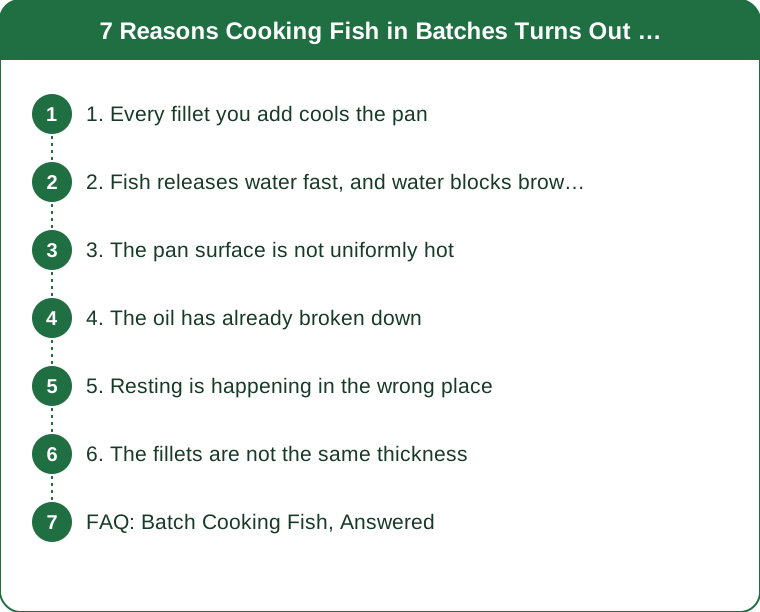
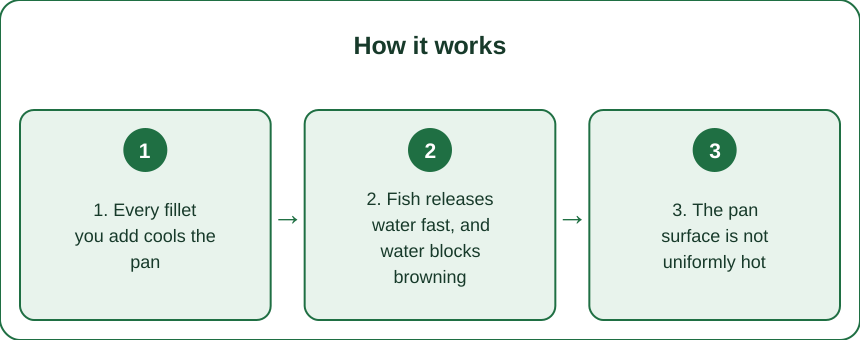
1. Every fillet you add cools the pan
A cold fillet absorbs a substantial amount of heat from the pan surface, and a thin pan cannot replace it fast enough.
The temperature drop is cumulative. Two fillets drop it twice as far, and the fourth arrives in a pan that is barely searing.
Below the searing threshold the surface proteins do not set, which is the direct cause of sticking.
A heavier pan holds far more heat energy, which is why cast iron and thick stainless outperform thin nonstick for this specific job.
Preheat longer than you think. Two minutes is not enough for a heavy pan; four to five is more realistic.
And cook in batches of two rather than four, wiping and reheating between them.
2. Fish releases water fast, and water blocks browning
Fillets release moisture within seconds of hitting heat, and one fillet’s worth evaporates quickly while four fillets’ worth pools.
Pooled water holds the pan surface at boiling temperature, which is far below the temperature browning requires.
Once you are steaming, no amount of extra time produces a crust - it produces overcooked fish with a pale exterior.
Drying the fillets thoroughly beforehand removes a real fraction of that water, and kitchen paper on both sides for a minute is enough.
Salting fillets fifteen minutes ahead and patting dry again draws out more and firms the surface.
And leaving space between fillets lets steam escape, which is the single most effective change most people can make.
3. The pan surface is not uniformly hot
Most domestic hobs heat a smaller area than the pan covers, so the edges of a large pan run cooler than the middle.
A fillet at the edge is cooking in a different pan than one in the centre, which is why batch results are inconsistent even within a batch.
Preheating longer evens this out by letting conduction spread heat across the base.
Rotating fillets from edge to centre halfway through compensates on a hob that cannot heat evenly.
Induction hobs are better at this but still leave a cooler ring at the outer edge of a large pan.
Matching pan size to burner size matters more for fish than for most foods, because the cooking window is short enough that uneven heat has no time to average out.

4. The oil has already broken down
Oil degrades over time at high heat, and by the third batch it has darkened and lost some of its performance.
Browned bits from earlier batches burn, contributing bitter flavours to later fillets.
Wipe the pan between batches with kitchen paper held in tongs, and add fresh oil.
Use an oil with a genuinely high smoke point for searing rather than a delicate finishing oil.
A thin, even film is enough - excess oil lowers surface contact and encourages steaming at the edges.
And save butter for the last thirty seconds, since it burns well below searing temperature and cannot survive several batches.
5. Resting is happening in the wrong place
Fillets held on a plate steam themselves, and the crust you built dissolves within two minutes.
A wire rack over a warm plate keeps the underside dry, which preserves the crust far better.
A low oven at around seventy degrees Celsius holds fish without cooking it further for a short window.
Covering with foil traps steam and is the most common way a good first batch gets ruined while waiting.
Fish carries over less than red meat but it does carry over, so pull batches destined for holding slightly earlier.
And keep the holding time short. Fish is genuinely worse after ten minutes of holding, however you do it.
6. The fillets are not the same thickness
Mixed thicknesses in one batch guarantee that something is over or undercooked, since the timing is set by the pan and not by each fillet.
Group fillets by thickness and cook the thick ones first, giving them a longer sear and a finish in the oven if needed.
Tail pieces cook considerably faster than the thick centre cut and should never share a batch with them.
Folding a thin tail under itself evens the thickness and is a standard restaurant trick.
Buying a centre cut rather than a whole side solves it at the shop, and is worth asking for at a counter.
And thickness matters more than weight for timing, which is why per-kilo cooking guidance is unreliable for fish.
FAQ: Batch Cooking Fish, Answered
How many fillets can I cook at once?
Enough that there is visible space between them - usually two in a standard domestic pan, three in a large one.
Why does the second batch always stick?
The pan cooled and the surface is no longer hot enough to set the proteins. Wipe, reheat, and add fresh oil.
Should I use nonstick for fish?
Nonstick prevents sticking but gives a weaker crust and usually cannot take searing heat. Heavy stainless or cast iron gives a better result if properly preheated.
How do I keep the first batch warm?
On a wire rack in a low oven, uncovered. Foil traps steam and softens the crust.
Do I need to dry the fish?
Yes. It is the highest-value thirty seconds in the whole process.
Can I just cook it all in the oven instead?
Yes, and for four or more portions it is often the better answer - roast at high heat on a preheated tray for an even result without any of this.
TL;DR:
- Crowding, not batching, is the problem: each cold fillet drops the pan temperature below the searing threshold.
- Fish releases water fast, and pooled water holds the surface at boiling temperature, where browning cannot happen.
- Use a heavy pan, preheat four to five minutes, dry the fillets thoroughly, and leave visible space between them.
- Wipe the pan and add fresh oil between batches; save butter for the last thirty seconds.
- Hold finished fish uncovered on a wire rack, never under foil, and keep the holding time short.
For four or more portions, a preheated tray in a hot oven beats the pan every time.
Keep Reading
This article is for general informational purposes only and is not medical advice. Always consult a qualified health professional for guidance specific to you.