8 Things That Decide Whether Fish Tastes Good Before You Cook It
Quick Answer: Most disappointing fish was compromised before cooking. Frozen-at-sea fish is often fresher than what is on the counter, thawing in the fridge overnight preserves texture far better than any fast method, and drying the surface thoroughly is what separates a seared fillet from a steamed one. Buy for the day you will cook, store on ice in the fridge, and never thaw at room temperature.
The recipe said sear four minutes a side for a golden crust.
You got grey, and it stuck, and it fell apart when you turned it.
The pan was fine. Two things went wrong the day before.

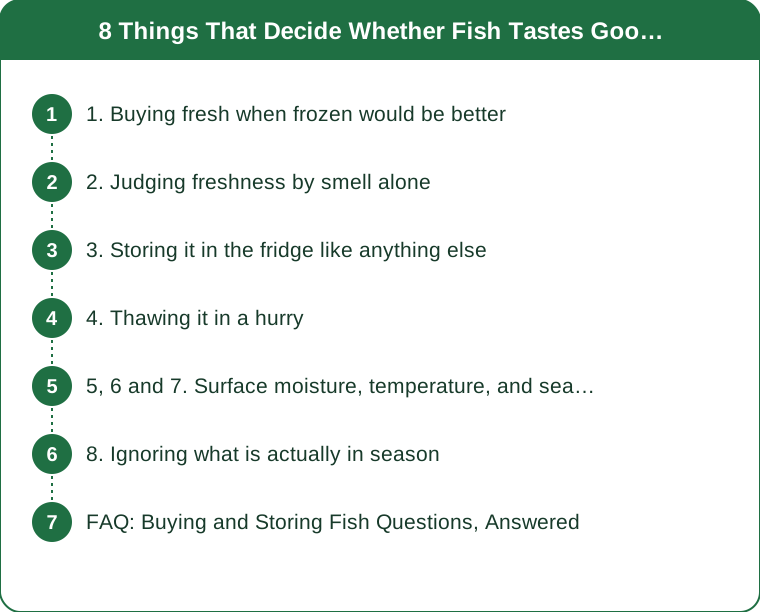
1. Buying fresh when frozen would be better
Most fish sold at a counter as fresh was previously frozen and thawed by the shop, which is legal and normal and rarely advertised clearly.
Frozen-at-sea fish is often frozen within hours of catch, at very low temperatures that preserve texture well. Counter fish may be several days off the boat.
Which means the frozen block is frequently the fresher product, and it is usually cheaper.
The practical advantage is control. You thaw it the day you want it, rather than buying on Tuesday and cooking on Thursday.
Look for vacuum-sealed portions with no visible ice crystals inside the packaging. Ice crystals inside the pack mean it thawed and refroze at some point, which damages texture badly.
Ask the counter directly whether it was previously frozen. A good fishmonger will tell you, and if it was, buying it frozen instead is strictly better.
2. Judging freshness by smell alone
Fresh fish should smell of clean sea water or of almost nothing. A strong fishy odor means it is past its best, and that part of the folk wisdom is correct.
But smell is the last signal to appear, not the first. By the time it smells, texture has already degraded.
Better indicators, in order:
Flesh that springs back when pressed. A dent that stays is a bad sign.
Clear, slightly domed eyes on whole fish rather than sunken and cloudy.
Bright red gills rather than brown or grey.
A moist, translucent surface rather than dull, dry, or gaping between the muscle flakes.
Gaping is particularly telling — when the connective tissue between flakes breaks down, the fillet begins to separate visibly, and that fish will fall apart in the pan no matter what you do.
3. Storing it in the fridge like anything else
Fish deteriorates roughly twice as fast at 40 degrees as at 32, and a normal fridge shelf is around 40.
Put it on ice inside the fridge. A container with a rack, ice underneath, fish on top, so meltwater drains away rather than sitting against the flesh.
Coldest part of the fridge if you have no ice — usually the bottom shelf at the back, never the door.
Cook it the same day or the next. Two days is the practical outer limit for most fresh fish, and shellfish is shorter still.
Do not store it in its wrapping paper. Move it to a covered container, since damp paper against the flesh accelerates spoilage.

4. Thawing it in a hurry
Overnight in the fridge is the best method by a clear margin. Slow thawing lets the muscle reabsorb the moisture released as ice crystals melt, which preserves texture.
Fast thawing — hot water, microwave, counter — releases that moisture as drip loss, and the fish is drier and softer as a result.
If you must be quick, use cold running water with the fish sealed in a bag. It is a compromise and it is far better than warm water.
Never thaw at room temperature. The surface reaches unsafe temperatures long before the center thaws, and it is genuinely a food safety issue rather than just a quality one.
Thin fillets can go into the pan from frozen for some cooking methods, which sidesteps the problem entirely — a frozen fillet baked or poached often turns out better than a badly thawed one.
5, 6 and 7. Surface moisture, temperature, and seasoning timing
5. Cooking it wet. This is the single most common reason fish steams instead of searing. Water on the surface must evaporate before the surface can reach browning temperature, and while it does, you are steaming.
Pat both sides thoroughly with paper towel, then leave it uncovered on a rack in the fridge for 20 to 30 minutes if you have time. The surface dries and the crust changes completely.
6. Cooking it fridge-cold. A cold center takes longer to cook through, so the outside overcooks while you wait. Fifteen minutes at room temperature before cooking evens this out considerably. Do not leave it longer than about 30 minutes.
7. Salting at the wrong moment. Salt draws moisture to the surface, which is exactly what you do not want just before searing. Salt either well ahead — 30 to 45 minutes, which gives time for it to reabsorb — or immediately before the fish hits the pan. The worst timing is five to ten minutes before, which is what most people do.
Delicate fillets are best salted right at the pan. Firmer fish like salmon or cod tolerate the longer approach and benefit from it.
8. Ignoring what is actually in season
Early autumn is one of the better times of year for a lot of species, and buying with the season rather than against it improves quality and price simultaneously.
Cooler water generally means firmer texture and higher fat content in many fish heading into winter, which is why autumn fish often tastes noticeably better than the same species in midsummer.
Shellfish availability shifts in autumn, and mussels in particular come into good condition as the water cools.
Ask the counter what came in today rather than what you planned to buy. The best fish in the shop on a given day is a better starting point than a recipe chosen in advance, and any decent fishmonger will tell you which one that is.
Buy the species that is abundant, not the one that is scarce. Scarcity in a fish counter usually means it traveled further and waited longer.
And be flexible about substitution — most white fish recipes work across several species, and cooking the good cod instead of the tired halibut is a better decision than following the recipe exactly.
FAQ: Buying and Storing Fish Questions, Answered
Is farmed fish worse than wild?
Not inherently, and it varies enormously by species and farm. Farming practices differ widely, and some farmed species are excellent while some wild fisheries are poorly managed. Certification schemes and a knowledgeable fishmonger are more useful guides than the farmed-versus-wild label alone.
How can I tell if frozen fish has been thawed and refrozen?
Ice crystals inside the packaging, frost on the fish itself, or a distorted shape. Any of those means the temperature rose enough to allow partial thawing, and the texture will be compromised. Buy a different pack.
Can I refreeze fish I thawed but did not cook?
Quality-wise it is a bad idea, and safety-wise it depends. If it stayed refrigerated the whole time and it has been under a day, cooking it and then freezing the cooked dish is the better option. Refreezing raw thawed fish gives you a noticeably worse product.
How long does cooked fish keep?
Three days refrigerated, in a sealed container. It is best on the day and acceptable the next, and cold cooked fish flaked into a salad is a genuinely good use for leftovers rather than a consolation.
Does rinsing fish before cooking help?
No, and it works against you. Rinsing adds surface moisture you then have to remove, and it can spread bacteria around the sink. Pat it dry and skip the rinse entirely.
TL;DR:
- Frozen-at-sea fish is frequently fresher than counter fish and gives you control over timing.
- Judge freshness by springy flesh, clear eyes, red gills, and no gaping — smell is the last signal.
- Store on ice inside the fridge and cook within a day or two.
- Thaw overnight in the fridge; never at room temperature, and never in warm water.
- Dry the surface thoroughly — wet fish steams instead of searing.
- Salt well ahead or right at the pan, never five minutes before.
- Buy what came in today rather than what the recipe specified.
Seven of these eight happen before the pan is hot, which is where most of the outcome is decided.
Keep Reading
This article is for general informational purposes only and is not medical advice. Always consult a qualified health professional for guidance specific to you.