7 Things That Change About Buying Seafood Once the Weather Cools
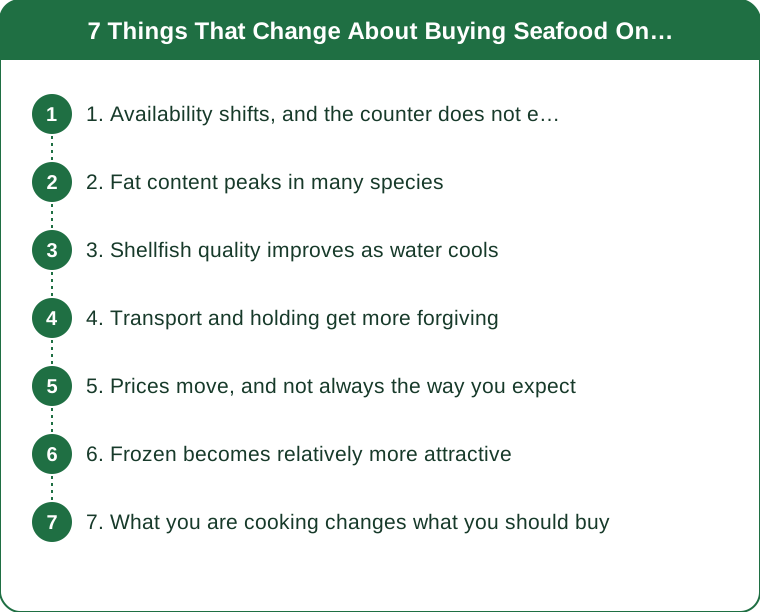
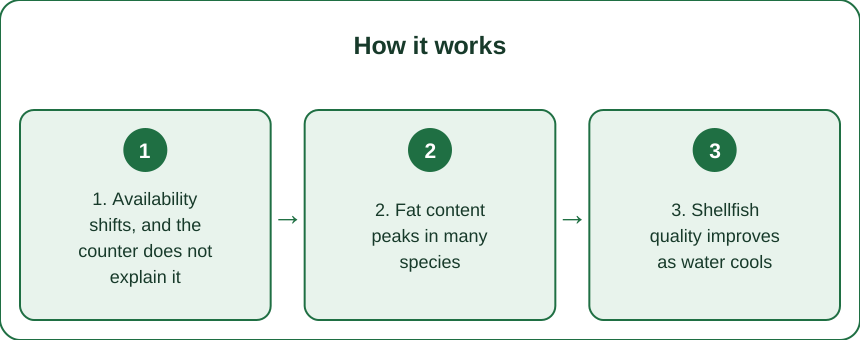
Quick Answer: Cooler months change seafood buying in seven ways: species availability shifts as fish move and seasons open and close, fat content in many species peaks, shellfish quality improves as water cools, transport and holding conditions get more forgiving, prices move on both supply and demand, frozen becomes relatively more attractive, and the cooking methods you are buying for change what cuts make sense. Knowing which is which turns a confusing counter into a straightforward one.
Here is what actually shifts.
1. Availability shifts, and the counter does not explain it
Fish are not evenly available through the year, and the changes in autumn are substantial.
Many species migrate seasonally, moving to different depths or latitudes as water temperature changes. Fisheries also open and close on managed schedules that follow spawning cycles. The result is that the species at their best in October are a genuinely different set than those at their best in June.
The complication is that a supermarket counter looks identical year round, because global supply chains fill gaps with imports and frozen-then-thawed product. You can buy almost anything at any time, which obscures the fact that some of it is at its best and some is not.
What to do: ask what came in most recently and what is local. A fishmonger who knows their stock will tell you immediately, and the answer is more useful than any seasonality chart, because it reflects what actually arrived at that shop this week.
At a supermarket, the tell is the label. Country of origin and whether it was previously frozen are usually printed, and they tell you a great deal about what you are actually buying.
2. Fat content peaks in many species
This is the reason autumn seafood has a reputation, and it is a real phenomenon rather than folklore.
Many fish build fat reserves through the warm months in preparation for winter and for spawning. By early autumn, species like mackerel, herring, and sardines are at or near their highest fat content of the year.
Fat matters enormously for eating quality. It carries flavor, it keeps the flesh moist during cooking, and it makes a fish far more forgiving of slight overcooking. The same species can be lean and disappointing at one time of year and rich and excellent a few months later.
This is most pronounced in oily fish, and it applies to a lesser degree across many species.
What to do: lean into oily fish in autumn. Mackerel in September is a genuinely different eating experience than mackerel in spring, and it is inexpensive. This is the season to cook the fish you might normally skip.
Cooking implication: higher fat means grilling and broiling work better, because there is enough fat to keep things moist under direct heat. It also means these fish spoil faster once bought, since fat oxidizes. Buy oily fish the day you cook it.
3. Shellfish quality improves as water cools
The old advice about months with an R in them has a real basis, even if the specifics have changed.
Oysters spawn in warm water. A spawning oyster diverts energy to reproduction, which leaves the meat thinner, softer, and less sweet. As water cools and spawning ends, oysters recover condition and become plump and firm.
Mussels and clams follow broadly similar patterns.
The historical safety element — the reason for the R months rule — was about warm-water bacteria and the absence of refrigeration. Modern harvesting, testing, and cold chains have largely addressed that, which is why oysters are sold year round now. The quality argument, though, is unchanged.
What to do: autumn through winter is oyster season for good reason. If you like them, this is when to eat them.
How to check: shells should be tightly closed, or should close when tapped. An oyster or mussel that stays open is dead and should be discarded. The shell should feel heavy for its size, which indicates it is full of liquor.
Buy from a source that can tell you the harvest date and location. Both should be available — shellfish are tagged, and a good shop will show you the tag.
4. Transport and holding get more forgiving
Cool weather is genuinely better for seafood quality, from boat to counter to your kitchen.
Every step of the chain involves temperature risk. Fish degrades fast, and the rate is strongly temperature-dependent — a few degrees warmer roughly halves the time it stays good.
In summer, that means the walk from the shop to your car and the drive home is a real quality factor, especially on a hot day. In autumn, the same journey costs much less.
It applies further up the chain too. Displays hold temperature more easily, delivery vehicles work less hard, and the margin for error at every handoff is wider.
What to do: you can be slightly more relaxed about the trip home in cool weather, and it remains worth bringing a cool bag for anything more than a short journey.
What not to relax about: how long it sits in your fridge. Buy fish for the same day or the next day. Cool weather improves the supply chain; it does not extend how long fish keeps once you own it.
One practical improvement worth adopting: ask for a bag of ice at the counter. Most fishmongers will give you one for free, and it makes the trip home irrelevant as a variable.
5. Prices move, and not always the way you expect
Seafood pricing responds to supply and demand simultaneously, and autumn moves both.
On the supply side, some fisheries open and others close. Weather affects how many days boats can fish, and autumn storms reduce fishing days in many regions. Rough weather means less landed fish and higher prices, and it is unpredictable week to week.
On the demand side, autumn brings a shift toward cooking at home and toward the kind of cooking that uses fish — soups, stews, roasts. Then the holiday season creates specific spikes for particular species.
What to do: stay flexible on species. Going to the counter to buy a specific fish means paying whatever it costs; going to buy the best value fish means eating better for less. A recipe that specifies a firm white fish rather than a named species is a much better recipe for real shopping.
Plan ahead for holidays. Species associated with holiday meals get expensive in the weeks before, and buying and freezing well in advance genuinely saves money.
6. Frozen becomes relatively more attractive
Frozen seafood is better than most people believe, and the calculation shifts in autumn.
Much commercial fish is frozen at sea, within hours of being caught, at temperatures far below a home freezer. That product is frequently fresher at the moment of freezing than anything that has spent days traveling to a counter.
The advantage in autumn is availability and consistency. When weather disrupts landings and the counter is thin, the freezer section is unaffected. And for species whose season has closed locally, frozen from peak season beats fresh from the other side of the world.
What to do: look for frozen-at-sea labeling, individually vacuum-sealed portions, and no visible ice crystals inside the packaging, which indicate thawing and refreezing.
Thaw properly. Overnight in the fridge, not on the counter and not in warm water. A rushed thaw is the single biggest reason frozen fish gets a bad reputation — the texture damage people blame on freezing is usually thawing damage.
One exception worth knowing: the fish at the counter labeled previously frozen is often the same product, thawed by the shop. In that case you are paying counter prices for freezer product, and you have lost the ability to control the thaw. Buying it still frozen is usually the better deal.
7. What you are cooking changes what you should buy
Autumn cooking is different, and it suits different cuts and species.
Summer seafood cooking skews toward quick, high heat: grilling, searing, a few minutes and out. Autumn moves toward braising, roasting, chowders, stews, and pies.
Those methods want different things. Long, gentle cooking suits firmer fish and cuts that would be unremarkable seared — the cheaper, denser species that hold together in liquid. Delicate fillets that are wonderful pan-seared fall apart in a stew.
What to do: buy for the method. For chowders and stews, firm white fish and smoked fish. For roasting whole, oily fish at their autumn peak. For pies, a mix including something smoked for depth.
Buy bones and heads. They are usually free or nearly so, and a proper fish stock is the entire difference between a good chowder and a great one. This is the season it becomes worth the effort.
Consider tinned and cured. Tinned sardines and mackerel, smoked fish, salt cod — all suit cooler weather cooking, all keep, and all are excellent value.
This is general information. Follow food safety guidance on raw and undercooked seafood, particularly if you are pregnant, immunocompromised, or cooking for young children or older adults.
TL;DR:
- Autumn shifts which species are at their best, and a year-round counter hides that — ask what came in most recently.
- Oily fish peak in fat content now, which makes them richer, more forgiving to cook, and excellent value.
- Shellfish improve as water cools and spawning ends; check that shells are heavy and closed.
- Cool weather makes the whole supply chain more forgiving, but does not extend fridge life — buy for the same or next day.
- Stay flexible on species, take frozen-at-sea seriously, thaw overnight in the fridge, and buy for the cooking method.
On your next trip, ask one question at the counter: what came in today? It is worth more than any list.
Keep Reading
This article is for general informational purposes only and is not medical advice. Always consult a qualified health professional for guidance specific to you.