7 Things Fishmongers Notice That Shoppers Walk Straight Past
Quick Answer: The single most useful check is the ice and the display itself, not the fish. Fish should sit on or in ice, not in melted water, with whole fish belly-down and never stacked directly on each other. After that, look for firm flesh that springs back, tight scales, and gills that are red rather than brown. Clear versus cloudy eyes is the cue most shoppers rely on and it is one of the least reliable, since eyes cloud from ice contact and handling as much as from age.
Most of what you need to know is visible before you look at a single fish.
This blog has covered why the smell test is backwards, why frozen fish is often fresher than counter fish, and why pan-seared fish sticks to the pan. This is the counter-side checklist that comes before all of it.

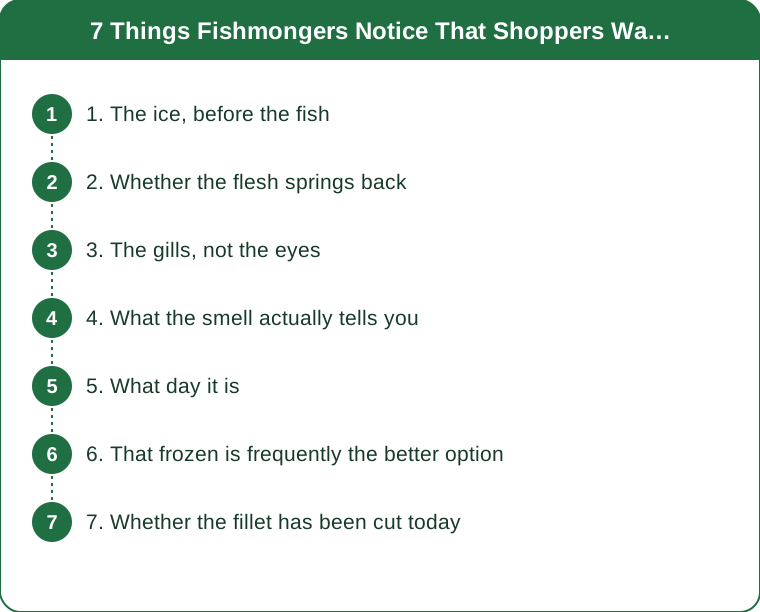
1. The ice, before the fish
A professional looks at the display first and the product second. Everything about how fish has been held is visible in the ice.
Fish should sit on ice, partially embedded, not floating in meltwater. Water pooling around fish means the ice has been melting for a while, which means the temperature has been rising and the display has not been maintained.
Fresh ice is crisp and defined. Old ice is slumped, glassy, and has clear channels where water has run through it.
Whole fish should be belly-down or on their side, not stacked on one another. Weight from stacking bruises flesh, and bruised flesh breaks down faster.
Look for separation between types. Fish sitting in another fish’s drip is a hygiene issue and it tells you about the standards of the counter generally.
A counter that looks well-tended almost always has better fish than one that does not, because the same person is making both decisions. This is the highest-information single observation available to a shopper.
2. Whether the flesh springs back
Press a fillet gently with a fingertip and watch what the dent does. Fresh flesh returns to shape within a second or two. Older fish holds the indentation.
This is the most reliable single test on a fillet and it is the one most shoppers never perform, usually because it feels rude. Any decent fishmonger will let you, or will press it for you if you ask.
The mechanism is protein breakdown. As fish ages, enzymes degrade the muscle protein structure that gives flesh its resilience. A dent that stays is that structure having gone.
On a whole fish, press along the flank behind the head. Same principle, and easier to assess because there is more muscle mass.
Ask before touching. Most counters are entirely happy to let you assess a fillet, and asking marks you as someone who knows what they are looking at, which tends to improve the service you get.
If you cannot touch it, look at how it sits. A fillet that drapes and sags over the edge of a tray has lost structure. A fresh fillet holds a shape.
3. The gills, not the eyes
On a whole fish, lift the gill cover and look at the colour. Bright red to deep pink is fresh. Brown, grey, or dull maroon means age.
Gills are the most reliable freshness indicator on a whole fish and it is where a professional looks first after the display.
Eyes are unreliable and everyone uses them. They cloud from being packed on ice, from handling, from freezing, and from the species itself. Plenty of perfectly fresh fish have somewhat cloudy eyes and plenty of older fish have clear ones.
Gills should also look clean and not slimy. A thin clear mucus is normal; thick, sticky, or discoloured mucus is not.
If the counter will not let you check gills, that is information too. There is no good reason to refuse, and a counter confident in its product generally welcomes the inspection.
For fillets, gills obviously do not apply, which is exactly why the spring-back test and the display quality matter so much more when buying fillets.

4. What the smell actually tells you
Fresh fish smells of the sea, of brine and cucumber and clean water. Not of fish.
The fishy smell is trimethylamine, a compound produced as fish tissue breaks down. Its presence means the process is well underway.
By the time you can smell it across a counter, it is quite far along. This is why the smell test is a poor primary check: it identifies fish you should already have rejected on other grounds.
Smell the whole counter, not one fish. A general fishy smell in the air around a display tells you about the counter’s turnover, which is more useful than any individual item.
Ammonia is a hard stop. Any ammonia note, particularly on shark, skate, or ray, means the fish should not be bought at any price. This is not a subtle judgement call.
Shellfish are different. Live shellfish should smell of clean seawater and nothing else. Any sourness or strong odour in mussels, clams, or oysters means discarding them.
5. What day it is
Deliveries arrive on a schedule and it is not the same every day. Most counters take delivery two to four times a week, and the fish on Sunday is frequently Friday’s.
Just ask when the delivery comes. This is a completely normal question and the answer will shape your shopping for years.
Monday is often the weakest day at many counters, though this varies enormously by region and by supplier, which is precisely why asking beats assuming.
Ask what came in today specifically. A good fishmonger will tell you, and will often steer you toward something better than what you came in for.
Ask what they would take home. This question gets remarkably honest answers and it is the fastest way to find the best item on a counter.
And notice whether the answer is specific. Someone who says the sea bream came in this morning from a named source is telling you something. Someone who says everything is fresh is not.
6. That frozen is frequently the better option
Most fish sold at a counter has been frozen already and thawed for display. This is entirely normal, and it means the choice is often between fish frozen once and fish frozen once then thawed and sat out for two days.
Frozen-at-sea fish is processed within hours of catch. Counter fish may be three to six days from the water by the time you see it, depending on the supply chain.
Look for the label. Previously frozen must generally be disclosed, and asking directly is normal. Buying thawed fish and then refreezing it at home is the thing to avoid.
For anything not being eaten today, frozen is usually the better buy. It goes in your freezer at peak quality rather than degrading in your fridge.
Thaw in the fridge overnight, never at room temperature or in water. Slow thawing preserves texture; fast thawing produces mushy flesh and is the reason frozen fish has an undeserved reputation.
Pat completely dry before cooking. Thawed fish holds surface water, and surface water is the direct cause of fish steaming rather than searing, and of it sticking to the pan.
7. Whether the fillet has been cut today
Look at the cut edge. A freshly cut fillet has a clean, slightly translucent edge. An older one looks dry, opaque, and slightly crumbly along the cut.
Gaping is the other tell. If the muscle flakes are visibly separating from one another, the connective tissue holding them has broken down. This happens with age and with rough handling.
Colour along the bloodline should be bright red, not brown. The dark strip along the centre of many fillets is one of the fastest-degrading parts, so it is a sensitive early indicator.
Ask them to cut from the whole fish if it is available. Many counters keep whole fish behind the display and will fillet on request. This is almost always fresher than what is pre-cut in the case.
Buy the thicker end. Tail-end fillets are thinner, cook unevenly, and dry out. The loin section from behind the head is the better piece and it costs the same per weight.
And plan to cook it the day you buy it. Even excellent fish declines noticeably within 24 hours in a home fridge. If that is not the plan, buy frozen, which is genuinely the better decision rather than a compromise.
TL;DR:
- Judge the ice and the display before you judge any fish. Meltwater, slumped ice, and stacked fish tell you everything.
- Press the flesh: fresh springs back within a second or two, older holds the dent.
- Check gills for bright red, not eyes for clarity. Eyes cloud for many reasons other than age.
- Ask when the delivery arrives and what they would take home. Both questions get useful, honest answers.
If you are not cooking it today, buy frozen. Frozen-at-sea fish is often fresher than what is thawed on the counter.
Keep Reading
This article is for general informational purposes only and is not medical advice. Always consult a qualified health professional for guidance specific to you.