7 Signs Your Fish Was Frozen Twice — and Why It Matters
Quick Answer: Refrozen fish has had its cell walls ruptured twice, so it holds far less water and turns mushy or cottony when cooked. The signs are visible before you buy: gapping between muscle segments, a milky liquid in the tray, dull sunken flesh, ice crystals inside vacuum packaging, and flesh that stays indented when pressed. Once you know what to look at, it takes about five seconds.
You did everything right. Good pan, hot oil, dry surface. And the fillet still fell apart into a pale, watery mess.
It was probably beaten before you got it home.

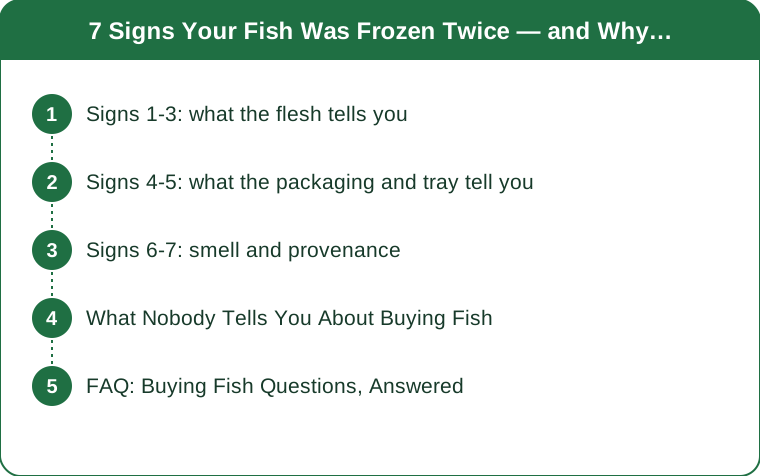
Signs 1-3: what the flesh tells you
1. Gapping between the muscle segments
Fish muscle is arranged in segments held together by thin connective tissue. Freezing forms ice crystals that damage that tissue; refreezing forms larger crystals and damages it more. The result is visible separation — small gaps or a flaky, shredded look along the fillet.
A once-frozen fillet looks continuous. A twice-frozen one looks like it is already coming apart, because it is.
2. The press test
Press gently with a fingertip. Fresh or properly frozen-once fish springs back within a second. Refrozen fish holds the indent, because the cell structure that produced that resilience has been ruptured.
This is the single most reliable test available at a counter, and most people never do it. Ask — a good fishmonger will not mind.
3. Dull, matte, or chalky surface
Good fish flesh has a translucent sheen, almost wet-looking without being slimy. Refrozen fish looks matte, opaque, and slightly chalky, particularly at the thin end of a fillet where damage concentrates.
White fish is easiest to read here. On salmon, look for a dull orange rather than a deep translucent one, and watch for white protein already leaching at the edges.
Signs 4-5: what the packaging and tray tell you
4. Milky liquid in the tray
A small amount of clear liquid is normal. A pool of milky, opaque liquid is not — that is protein and water that have escaped ruptured cells, and it is the clearest sign that this fish has been through more than one freeze.
This liquid is also why refrozen fish steams instead of searing. There is more free water at the surface than a hot pan can drive off.
5. Ice crystals inside a vacuum pack
In sealed frozen fish, look for large crystals or a build-up of frost inside the bag. Properly frozen-once fish, particularly frozen-at-sea, has minimal internal ice because it was frozen fast.
Large crystals mean either a slow freeze or a thaw-and-refreeze cycle, usually during transport or storage. Frost on the outside of the bag can just be freezer burn on the packaging; frost and crystals inside, against the fish, is the meaningful signal.
Also worth checking: a vacuum pack that has lost its seal and gone loose. That fish has warmed at some point.

Signs 6-7: smell and provenance
6. Smell that is flat rather than fishy
Counterintuitive, but useful. Very fresh fish smells of clean seawater or almost nothing. Old fish smells fishy and ammoniated. Refrozen fish often smells of nothing at all — flat and neutral, because the volatile compounds that give fish its fresh sea smell have been lost through repeated cell damage and moisture loss.
A fillet that looks fine and smells like absolutely nothing is worth a second look.
7. Fresh fish on a counter that is not near an ocean
Not a defect, just arithmetic. Most fish sold as fresh at inland counters was frozen at sea and thawed for display. That is fine — frozen-at-sea fish is often better than what was landed a week ago. The problem is when a shopper buys that thawed fillet and puts it in their home freezer, which is the second freeze.
This is the most common way refreezing happens: not at the supplier, but at home. Ask directly: ‘was this previously frozen?’ A good counter will tell you, and if the answer is yes, buy it to cook that day or the next.
What Nobody Tells You About Buying Fish
Frozen-at-sea often beats fresh. Fish frozen within hours of catch, at very low temperatures, retains texture and flavour better than fish that has been on ice for five days in transit. The prestige of ‘fresh’ does not track quality once you are more than a day from the boat.
A home freezer freezes too slowly to be neutral. Commercial blast freezers hit -30°F or lower in minutes, producing tiny crystals. A home freezer at 0°F takes hours, producing large ones. Freezing fish at home is always a texture cost — sometimes a worthwhile one, but never free.
Thawing method matters as much as freezing. Thawing in the fridge overnight preserves texture far better than a countertop or a warm water bath. Fast thawing produces more drip loss, which is the same mechanism as refreezing damage.
Refrozen fish is a texture problem, not automatically a safety problem — provided it stayed cold throughout. The risk arises when the thaw happened at unsafe temperatures. If you have any doubt about the cold chain, do not buy it.
Some fish hide it better than others. Dense, oily fish like tuna and mackerel show refreezing less than delicate white fish like cod, sole, and flounder. If you suspect a counter’s handling but want to buy anyway, choose the denser species.
FAQ: Buying Fish Questions, Answered
Can I rescue a refrozen fillet?
Partly. Salt it lightly and leave it on a rack in the fridge, uncovered, for 30-40 minutes before cooking — this draws out surface moisture and firms the exterior. Then pat completely dry and cook hot and fast. It will still be softer than good fish, but it will sear rather than steam. Poaching and curries are more forgiving than pan-searing.
Is it always wrong to freeze fish at home?
No — it is a reasonable trade when the alternative is waste. Freeze it the day you buy it, not on day three; wrap it tightly to exclude air; and use it within two to three months. Just do not freeze fish that was sold thawed, because that is the second freeze that causes the damage described here.
Why does my fish stick to the pan even when it looks good?
Surface moisture and an insufficiently hot pan, in that order. Pat the fillet completely dry, salt it 15 minutes ahead and pat again, and let the pan get properly hot before the oil goes in. Excess moisture is also the reason refrozen fish sticks so reliably — there is simply more water to boil off.
TL;DR:
- Press the fillet: if the indent stays, the cell structure is damaged. This is the fastest test you have.
- Look for gapping between muscle segments, a matte chalky surface, and milky liquid in the tray.
- Ice crystals inside a vacuum pack mean a slow freeze or a thaw-refreeze cycle.
- Fish that smells of nothing at all is a warning, not a good sign.
- Most home refreezing happens by accident — ask whether it was previously frozen and cook it within a day or two if so.
The habit worth building is asking one question at the counter: was this previously frozen? It is not a rude question, good fishmongers answer it happily, and the answer decides whether the fillet goes in your freezer or on your plate tonight. That single decision prevents most of the disappointing fish people end up cooking.
Keep Reading
This article is for general informational purposes only and is not medical advice. Always consult a qualified health professional for guidance specific to you.