7 Reasons Fish Sticks to the Pan and the Fix for Each One
Quick Answer: Fish sticks for seven distinct reasons, and the most common one is moving it too early — protein needs 60 to 90 seconds to form a crust that releases on its own. The others are a pan that is not hot enough, wet fish, too little fat, a crowded pan, a damaged non-stick surface, and cold fish straight from the fridge. Fix them in that order and sticking mostly stops being a thing that happens to you.
The common advice is use more oil, which addresses one of the seven.
Here is the diagnostic version.

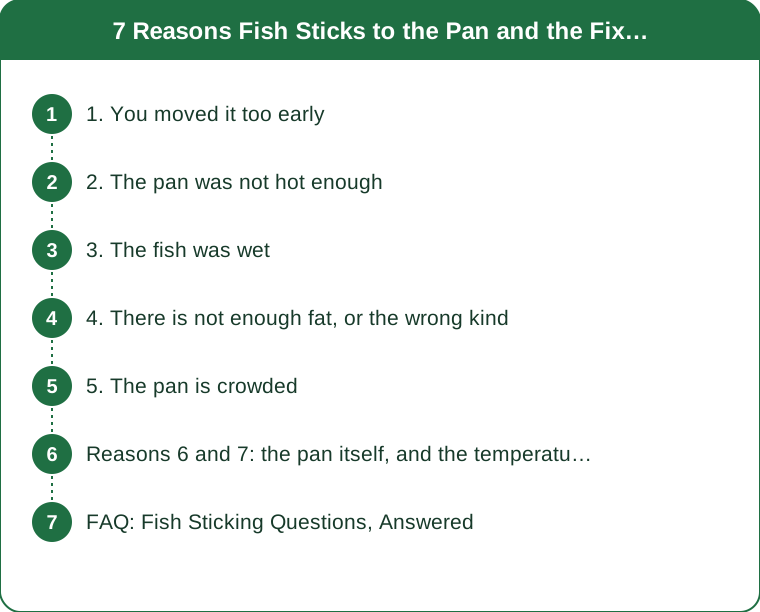
1. You moved it too early
The single most common cause, and it feels exactly like the right thing to do.
When fish hits a hot pan, the surface proteins begin to denature and bond — both to each other and, briefly, to the metal. Over the next 60 to 90 seconds those bonds reorganise into a crust that lifts away from the surface cleanly. During that window the fillet genuinely is stuck, and if you try to move it you tear it.
What happens next is predictable. You feel resistance, you conclude it is sticking, you work the spatula under it, and you leave half the skin in the pan. Then you add more oil next time, which does not help.
The fix: place the fillet and do not touch it. Not to check, not to reposition. Wait until the edges have turned opaque and you can see colour developing, then try to slide it gently. If it resists, wait another twenty seconds.
The test: a properly crusted fillet releases with a slight nudge. If it needs force, it is not ready. This one rule prevents most sticking.
2. The pan was not hot enough
Too cool is far worse than too hot for fish.
A pan that is not properly preheated does not sear. Instead, the surface of the fish warms slowly, releases moisture, and that moisture sits between fish and metal. Proteins bond to the surface without forming the crust that would let them release, and you get adhesion without browning — the worst combination.
High heat drives moisture off fast enough that the crust forms before the sticking sets in.
The fix: preheat the pan properly before any oil goes in, then add the oil and let it shimmer. For most fish you want a pan hot enough that a drop of water skitters rather than sits.
The check: the fish should sizzle audibly and immediately on contact. If it goes in quietly, take it out, let the pan get hotter, and start again — you have lost nothing.
This is also why the second fillet often behaves better than the first: the pan has finally reached temperature.
3. The fish was wet
Surface moisture is the enemy of every part of this.
Water on the surface of a fillet has to boil off before any searing can happen. While it does, the fish is steaming rather than searing, the pan temperature drops, and the crust does not form.
Fish is wetter than most people realise — from the counter, from the packaging, from thawing, and from its own moisture drawn out by salt.
The fix: pat both sides thoroughly dry with kitchen paper immediately before cooking. For skin-on fillets, dry the skin twice and scrape the skin gently with the back of a knife to remove moisture that the paper leaves behind.
Timing matters with salt. Salting well in advance draws moisture to the surface. Either salt 40 minutes or more ahead, so the moisture is drawn out and reabsorbed, or salt immediately before it goes in the pan. Salting five minutes ahead is the worst option, and it is what most people do.

4. There is not enough fat, or the wrong kind
Fat is a barrier, and it needs to be continuous and stable.
Too little oil means the fillet contacts bare metal in places, and those places stick regardless of everything else. The oil layer needs to be complete across the area the fish will occupy — you should see it move as a sheet when you tilt the pan.
Smoke point matters as much as quantity. Oil that has passed its smoke point breaks down, loses its lubricating quality, and leaves residue that fish grips onto. Extra virgin olive oil is a common culprit at searing temperatures.
The fix: use enough oil to cover the pan surface completely — roughly 1 to 2 tablespoons for a 24cm pan — and choose something with a high smoke point: refined olive, avocado, grapeseed, or clarified butter. Add whole butter later for flavour, once the crust has formed.
A good sequence: hot pan, oil in, shimmer, fish in. Oil added to a cold pan and heated with it tends to break down before the fish arrives.
5. The pan is crowded
Two fillets in a pan sized for one is a steaming setup.
Each fillet releases moisture as it cooks. In a pan with space, that moisture evaporates and leaves. In a crowded pan, it has nowhere to go, the temperature drops, and everything steams in its own liquid — which sticks.
Crowding also makes the pan harder to work with. You cannot get a spatula in cleanly, so you end up levering rather than sliding.
The fix: leave at least 2cm between fillets and between fillets and the pan wall. Cook in batches, and keep the first batch warm in a low oven. Two batches of properly seared fish beats one batch of steamed fish comfortably.
The alternative: use a bigger pan. A 28 or 30cm pan handles three fillets where a 24cm handles two, and the larger surface also recovers temperature faster when the fish goes in.
Reasons 6 and 7: the pan itself, and the temperature it meets
6. The non-stick coating is finished
Non-stick surfaces have a working life and they end quietly.
Non-stick coatings degrade with heat, with abrasion, and with age. A pan that has been through several hundred cycles, been scrubbed, or been taken above its rated temperature will have lost much of its release properties even if it looks broadly fine.
The telltale sign is inconsistency: eggs still work, delicate fish does not. Fish skin is one of the most demanding things you can ask of a non-stick surface, so it is often the first thing to reveal that a pan is finished.
The fix: for fish, a well-maintained carbon steel or cast iron pan outperforms a mediocre non-stick and lasts indefinitely. Stainless steel works well too, provided the pan is properly preheated — the technique matters more on stainless, and the results are better.
If you are using non-stick, keep the heat moderate, never preheat it empty, and accept that it is not the right tool for a hard sear.
7. The fish went in cold
Straight from the fridge is a temperature problem and a moisture problem at once.
A cold fillet cools the pan surface sharply on contact, which drops it below searing temperature for the crucial first thirty seconds. It also has more condensation on its surface, having just come from cold into warm air.
Thicker fillets suffer most, since the temperature differential is larger and the cooking time longer.
The fix: let fillets sit at room temperature for 15 to 20 minutes before cooking, patting dry at the end of that time rather than the beginning. Twenty minutes is enough to take the chill off without any food safety concern for fish you are about to cook thoroughly.
And a related point for frozen fish: thaw fully and dry very thoroughly. Partially thawed fish releases a great deal of water into the pan and is one of the most reliable ways to produce sticking, steaming and a grey exterior all at once.
This is general information about cooking technique. Follow standard food safety guidance for storing and cooking fish, and cook fish thoroughly unless you are confident it is suitable for raw or rare service.
FAQ: Fish Sticking Questions, Answered
Should I cook skin-side down first?
Yes, almost always. Skin protects the flesh, crisps well, and releases cleanly once crusted. Press the fillet gently flat for the first ten seconds so the skin makes full contact rather than curling.
Does flouring the fish help?
It does, genuinely — a thin dusting of flour absorbs surface moisture and creates a layer that browns and releases well. Shake off the excess, and note that it changes the texture, which some people prefer and some do not.
Why does it stick more with some fish than others?
Delicate white fish with high moisture content — sole, plaice, cod — stick more readily than firmer, oilier fish like salmon or mackerel. Oily fish bring their own fat to the interface, which helps.
Is stainless steel really better than non-stick for fish?
Better results, less forgiving technique. A properly preheated stainless pan sears beautifully and releases cleanly. A poorly preheated one is the worst of all options.
What if it has already stuck?
Stop pulling. Turn the heat up slightly for twenty seconds — often the crust finishes forming and releases on its own. If it does not, slide a thin fish spatula in from the side rather than levering from underneath.
TL;DR:
- Moving it too early is the biggest cause — a crust needs 60 to 90 seconds and then releases on its own
- A pan that is not hot enough steams instead of searing, which sticks without browning
- Dry the surface thoroughly, and salt either 40 minutes ahead or immediately before, never five minutes ahead
- Use enough high-smoke-point oil to cover the pan completely, and leave 2cm between fillets
- Cold fish drops the pan temperature at the worst moment, so rest it 15 to 20 minutes first
Next fillet: hot pan, dry fish, oil shimmering, then leave it completely alone for ninety seconds. Six of the seven causes disappear in that one sentence.
Keep Reading
This article is for general informational purposes only and is not medical advice. Always consult a qualified health professional for guidance specific to you.