7 Fish Cooking Mistakes That Happen Before the Pan Gets Hot
Quick Answer: The main determinants of good fish are surface dryness, temperature before cooking, salt timing, pan choice, and knowing when to stop - and four of the five happen before any heat is applied. Wet fish steams rather than sears, fridge-cold fish cooks unevenly, salt applied at the wrong time draws moisture to the surface, and fish carries over so much residual heat that pulling it at the right moment means pulling it while it looks slightly underdone.
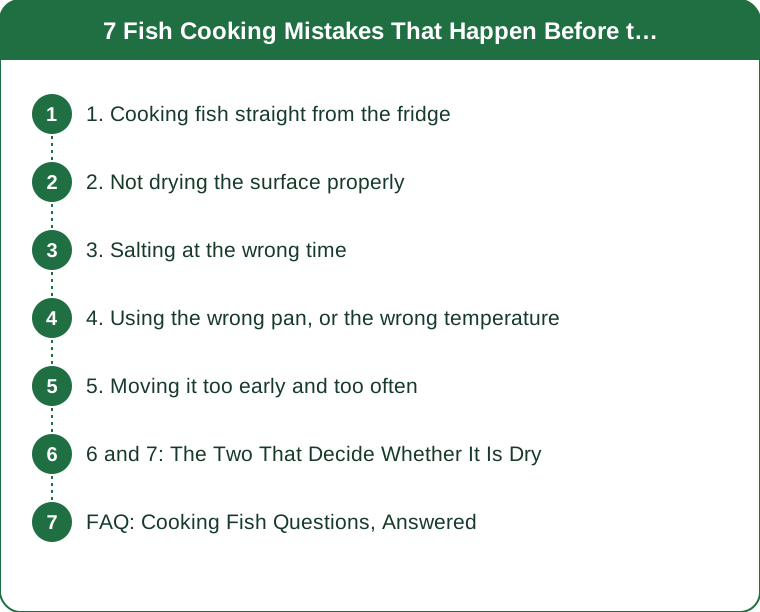
Seven mistakes, in the order they happen.

1. Cooking fish straight from the fridge
A cold fillet cooks unevenly. The exterior overcooks while the centre is still coming up to temperature, which produces the dry outside and undercooked middle that people blame on timing.
Take fish out 15 to 20 minutes before cooking. Not longer - fish is more perishable than meat and should not sit at room temperature for extended periods. Fifteen minutes takes the chill off without any food safety concern.
Thickness dictates how much this matters. A thin fillet is relatively forgiving; a thick piece of salmon or cod straight from the fridge is nearly impossible to cook evenly in a pan.
Frozen fish must be fully thawed unless a recipe specifically says otherwise. Thaw overnight in the fridge, or in a sealed bag in cold water for a faster result. Never at room temperature.
And the thawing method affects the texture. Slow fridge thawing preserves texture better than fast methods, and fish thawed in water without a sealed bag absorbs water - which then works directly against the drying step that comes next.
2. Not drying the surface properly
Surface moisture is the single biggest reason fish sticks and fails to brown. Water must evaporate before the surface can reach browning temperature, so a wet fillet steams itself for the first minute or two instead of searing.
And steam is exactly what prevents a crust. The Maillard reaction that produces browning and flavour requires a dry surface and high temperature, and it cannot start while water is boiling off.
Pat thoroughly with paper towel on both sides. For skin-on fish, the skin side especially - crisp skin is entirely a function of a dry surface meeting a hot pan.
For very crisp skin, dry further. Leave the fillet uncovered on a rack in the fridge for 30 minutes to an hour. The circulating cold air dries the surface in a way that patting cannot match.
And dry again immediately before it goes in the pan. Fish releases moisture as it sits, so a fillet dried five minutes ago is damp again - this is the step almost everyone skips.
3. Salting at the wrong time
Salt draws moisture to the surface through osmosis. Salting immediately before cooking puts water exactly where you just worked to remove it.
Two windows work, and the gap between them does not. Either salt immediately before cooking - within a minute, before moisture is drawn out - or salt 30 to 45 minutes ahead, so the moisture is drawn out and then reabsorbed with the salt, seasoning the flesh throughout.
Salting 10 minutes ahead is the worst option, and it is the most common. You get surface moisture with no time for reabsorption.
The longer method also firms the texture and seasons more evenly, which is why it is standard practice in professional kitchens. Pat dry again after the resting period.
And season the pan side more generously than you think. Much of it stays on the surface rather than penetrating, and under-seasoned fish is far more common than over-seasoned.

4. Using the wrong pan, or the wrong temperature
A pan that is not hot enough is the second major cause of sticking. Fish protein bonds to metal at low temperatures and releases naturally once a crust forms - which is why patient, hot cooking sticks less than cautious, cool cooking.
Heat the pan first, then add the oil, then the fish. Adding oil to a cold pan and heating them together degrades the oil and gives you no clear signal for when the pan is ready.
Use an oil with a high enough smoke point. Neutral oils suit high-heat searing; butter alone burns before fish is done, which is why the standard approach adds butter near the end rather than at the start.
Do not crowd the pan. Multiple fillets drop the surface temperature and release moisture into a small space, which turns searing into steaming. Cook in batches.
And choose the pan for the fish. Delicate fillets are far more forgiving in a good non-stick pan; stainless or cast iron gives a better crust on sturdier fish but demands correct temperature. Using cast iron for a fragile fillet is how fish ends up in pieces.
Press skin-on fillets gently for the first 20 to 30 seconds. Skin contracts as it heats and lifts the fillet off the surface. A light press with a spatula keeps contact even and is the difference between fully crisp skin and a curled edge.
5. Moving it too early and too often
Fish releases from the pan when a crust has formed. Trying to move it before that tears the surface and leaves half the fillet stuck - and the response is usually to force it, which makes it worse.
Place it and leave it. For most fillets, the first side takes several minutes undisturbed. When it releases easily with a gentle nudge, it is ready to turn.
Turn once. Repeated flipping prevents crust formation on both sides and increases the handling that breaks delicate fish apart.
Place it away from you. Laying the fillet down starting at the near edge and moving away avoids splashing hot oil toward you and gives more control over placement.
And cook skin side first, for most of the time. Skin-on fillets are typically cooked most of the way on the skin side, then finished briefly on the flesh side - which protects the delicate flesh and maximises crisping.
6 and 7: The Two That Decide Whether It Is Dry
6. Cooking it until it looks done
Fish carries over significantly after leaving the heat. Residual heat keeps cooking it, so fish pulled at perfect doneness in the pan is overdone on the plate.
Pull it when the centre is still slightly translucent. It will finish during the couple of minutes it rests. This is the single hardest habit to build because it requires trusting a process you cannot see.
Use flaking as the test, gently. The flesh should just begin to separate along its natural lines when pressed with a fork. Fish that flakes apart easily and completely is already overdone.
Thin fillets cook far faster than people expect - often just a few minutes total. A large share of overcooked fish is thin fillets given a thick fillet’s timing.
And different species differ. Salmon and tuna are commonly served with a translucent centre; white fish is generally cooked through but still just-set. Applying one standard across all fish produces poor results for some of it.
7. Skipping the rest
Fish benefits from a short rest, though a much shorter one than meat - two to three minutes is enough.
During that time carryover finishes the cooking and the juices redistribute, which is why a rested fillet is noticeably moister than one cut into immediately.
Rest it on a warm plate, not in the pan. Leaving it in a hot pan continues active cooking rather than resting, which produces exactly the overcooking you were trying to avoid.
And add acid at the end, not the beginning. Lemon juice added during cooking does not brighten the way it does when added at the table - and acid applied early to raw fish begins to denature the surface, which changes the texture.
This is general food information. Follow local food safety guidance for fish, particularly for raw or lightly cooked preparations, and take extra care if you are pregnant, elderly, very young, or immunocompromised.
FAQ: Cooking Fish Questions, Answered
Why does my fish always stick to the pan?
Usually a wet surface, a pan that is not hot enough, or moving it too early. Fish releases naturally once a crust forms - patience is the technique.
When should I salt fish?
Either immediately before cooking, or 30 to 45 minutes ahead so moisture is drawn out and reabsorbed. Salting around 10 minutes ahead is the worst of both.
How do I get crispy skin?
A very dry surface, a properly hot pan, skin side down first, and a gentle press for the first 20 to 30 seconds to stop the skin curling away from the heat.
How do I know when fish is done?
Pull it while the centre is still slightly translucent - carryover heat finishes it during a two to three minute rest. Fish that flakes apart completely in the pan is already overcooked.
Should I bring fish to room temperature first?
Take it out 15 to 20 minutes ahead, no longer. It cooks far more evenly, particularly for thicker fillets, without any food safety concern.
Is frozen fish worse than fresh?
Not necessarily - much frozen fish is processed very soon after catching. Thaw it slowly in the fridge and dry it thoroughly, since thawing adds surface moisture.
TL;DR:
- Take fish out of the fridge 15 to 20 minutes ahead - cold fillets cook unevenly, especially thick ones.
- Dry the surface thoroughly, then dry it again right before it goes in. Wet fish steams instead of searing.
- Salt immediately before, or 30 to 45 minutes ahead - never in the 10-minute middle ground.
- Heat the pan first, then add oil, then the fish. Do not crowd it, and match the pan to the fish’s fragility.
- Place it and leave it. Fish releases when a crust forms; turn once, and press skin-on fillets for the first 20 to 30 seconds.
- Pull it while the centre is still slightly translucent - carryover finishes the job during a two to three minute rest.
- Acid at the end, on a warm plate, never in the hot pan.
Most of the outcome was decided before the pan got hot.
Keep Reading
This article is for general informational purposes only and is not medical advice. Always consult a qualified health professional for guidance specific to you.